Book talks for readers at Chisago Lakes Middle School.

Wednesday, April 20, 2011

Will Weaver visits CLMS!

CLMS recently had the honor of hosting a visit from award winning author Will Weaver. A short interview with Mr. Weaver and pictures from his visit are posted below.


BCBT INTERVIEW WITH WILL WEAVER:

1. What do you find rewarding as a writer?

A: The act of creation, that is, making something (a novel or a story) out of nothing. It's what artists of all kinds really do. And after that, getting to interact with people/kids who have read my writing.

>2. What boundaries or limits do you set for yourself when writing for a particular audience?

A: Very thoughtful question.... Hmmmm, I need to think about that a sec. Okay, I've thought about it, ha. Writing a particular story or novel is itself a process of setting boundaries and establishing limits. I decide to have my novel take place during three months of a summer (FULL SERVICE), or a winter (THE SURVIVORS, forthcoming sequel to MEMORY BOY). Same goes for student writing in school. If you're doing a research paper on, say, the Civil War, we need to narrow our topic. How about one battle on one afternoon with the 1st Minnesota regiment? See what I mean about narrowing the topic? It's nearly always best to write in more detail about less, rather than more generally about a broad topic.

>3. Have you ever dealt with rejection from a publisher? How do you face challenges like rejection?

A: Yes. Just recently a publisher turned down a novel I thought was really good. So now I have to consider that they're seeing something that I'm not. I could just get mad about the rejection, but that doesn't help. I have to go back and try to see the novel through their eyes. And maybe I'll find that revisions are needed.

>4. What projects do you have in mind for the future?

A: I have in mind a young adult novel that's a combination of Lois Lowry's THE GIVER and Shirley Jackson's story "The Lottery." Won't say any more than that. Writers are also readers, and we sometimes use other writers' work as a "platform" -- as a basis for new stories of our very own. Literature is a lot about that kind of continuity.

>5. Can you give us a teaser about Survivors, the sequel to Memory Boy? You didn't tell us what happens to Emily the goat, but is there anything you can give us?

A: The Newell family has to survive a winter in a small cabin in the woods, and–-surprise--it's Sarah who really steps up and becomes important to the family's survival.
>
>6. What are your thoughts about e-readers?

A: Is changing rapidly from print/paper books to e-technologies, but I have no problem with that. Content (the stories, the lessons of literature) is more valuable than in what form it is read. Really, I think good and exciting things are happening with e-books and e-reading.

>7. Finally, how does it feel to be dubbed by some of our students as the "Justin Bieber of Books?"

A: Whoa, I'm still in shock over that! Now if I could only sing like Bieber... And thanks to everyone at CLMS for a great visit.

To read more about Will Weaver go to:willweaverbooks.com


BCBT gives a big shout out to: Cortney Walbridge, Tara Lindahl, Carla Lydon, and the East Central Regional Library System for making Mr. Weaver's visit possible for our students!

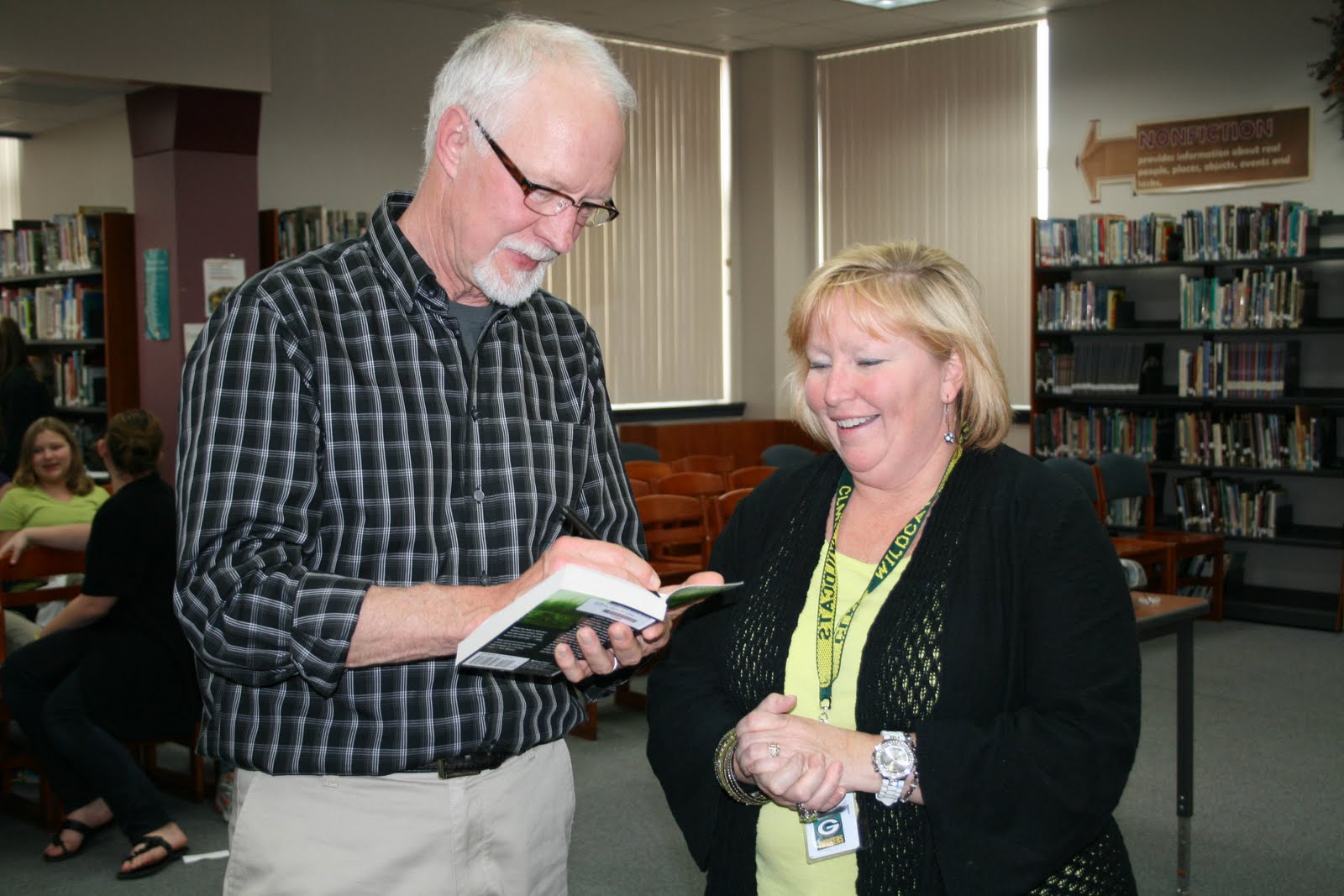

BCBT would also like to thank Denise Lange for all the displays and her special touch with everything. Thanks for your contributions to a special afternoon with Will Weaver.


Finally, BCBT would like to thank the students in CLMS B.O.B. for all their contributions to a successful author visit! Good job, you guys!

Monday, April 18, 2011

Memory Boy by Will Weaver


The Scream, an expressionist painting by the Norwegian artist Edvard Munch, rivets our attention to a trembling human form in extreme distress. As you gaze over it with your eyes, you may wonder what makes the alien-like form howl with fright. Surprisingly however, another element in the painting occasionally receives more attention. Those that view the painting today might want focus their attention on the reddish swirls in the background.

Scientists speculate that the unusually vivid background in The Scream may reveal a connection to one of the most powerful volcanic eruptions in recorded history-the eruption of Krakatoa.

In the late 1800's, ash from Krakatoa swirled around the globe possibly at the same time Edvard Munch finished The Scream. This would explain the vivid red swirls. Ash particles from the destructive Krakatoa eruption could have ironically resulted in some of the most magnificent sunsets ever witnessed on earth.

Considering other more recent cataclysmic events in the form of tsunamis, earthquakes, mega oil spills, not to mention a potential cataclysm in the form of a caldera of molten lava 1500 square miles in size lurking just 5 miles below Yellowstone Park, we may just consider the setting in the story, Memory Boy, by Will Weaver, more than plausible.

The story takes place in Minnesota, but the event that triggers all the action begins as a massive volcanic eruption in the Cascade Mountain Range on the West Coast. The volcanic event is more than 50 times the scale of the 1980 Mt. St. Helen’s eruption. As ash spews over most of the country, a teenager named Miles Newell eventually catches on that his carefree life will soon be over. Under a blanket of volcanic ash, the bread basket of the world slowly dies. The national crisis gets so severe, that instead of pulling together, people start living like it is survival of the strongest. Even in Miles neighborhood mild mannered people begin to act towards each other like a bad remake of the novel, The Lord of the Flies. With violence on the rise, and Mile’s family’s mansion a likely target for looters, the Newell family decides to make a run for it to the Brainerd Lakes Area. A safe, quiet, tranquil cabin awaits them. There’s only one problem-fuel has been rationed and there is no way for the family to get there by any gas-powered vehicle.

Will Miles figure out a way to help his family escape? Will the Newell family reach their beloved lake cabin before the chaos spilling into the suburbs of Minneapolis makes their way impassible? And, if they can reach their destination, how will the Newell family survive without fuel, electricity and any basic knowledge on how to live off the land? If you like a hard edged dystopian page turner, I would recommend Memory Boy, by Will Weaver.

Tuesday, March 8, 2011

Words in the Dust by Trent Reedy


“One man’s mission to promote peace...one school at a time.”

These words come from the subtitle of a book called, Three Cups of Tea, by Greg Mortenson. In the book Mortenson tells of how Afghan villagers nurse him back to health after his failed attempt to climb K2, the second highest mountain in the world. To return the generosity shown him, Mortenson makes a pledge to build a school for the village. Since then, he has made his life’s mission to build schools in a country where two thirds of the population cannot read. In addition, Mortenson has been an advocate for providing girls in Afghanistan with the opportunity to go to school in a country that traditionally has closed off education to women.

Mortenson has sold about 4 million copies of his book so far. The powerful story convinced President Obama to donate $100,000 dollars of his Nobel Peace Prize to a charity associated with Mortenson. Three Cups of Tea has even been made required reading for U.S. military personal assigned to serve in Afghanistan. The campaign to build schools fits in well with overall U.S. military strategy to win the hearts and minds of the Afghan people. Only one problem-CBS’s 60 Minutes revealed that parts of Mortenson’s story aren't true. Now there are even questions about how the money donated by President Obama and many others has been used for other purposes besides the construction of schools. As questions about Mortenson’s integrity surface, I can imagine the Taliban snickering under a rock somewhere. Winning the hearts and minds of the Afghan people is challenging enough already for our military and only made more difficult when we can't back up our words with deeds. If you had to dodge bombs, bullets and corruption on a daily basis, would you welcome an American soldier into your village just because he called you “rafiq” (friend)?

In the book, Words in the Dust, a girl named Zulaikha has to dodge something more terrifying than bullets. Her stomach feels twisted. She can't make her body stop shaking. In front of her, a group of boys stands in her way, ready to hurl rocks and insults at her face. Rocks or insults, which would hurt the most? Zulaika did the only thing she could think of-she ran. Just when she thought she was safe a loud roar stopped her like a brick wall. A gigantic tan humvee turned the corner.

“On top was a big gun with a barrel like a cannon. What looked liked a very tall man was really the top half of a soldier standing straight up through the roof of the vehicle behind the gun.”

Zulaika didn’t know that the American soldier was in her village to propose the idea of a school, one that would even allow girls to attend. All Zulaika knew at that moment was the fear that an American soldier had seen her face. Women in Afghanistan traditionally wear a chador, a head covering held closed in the front, but Zulaika had left her face exposed. As she raced back to her home, the soldier reported back to his commanding officer what he had seen. Little did Zulaika know then that the soldiers would later offer her one of the most precious gifts she could possibly imagine.

Will a school be built in Zulaika's village? Will she get permission from her father to attend? Why was an American soldier ready to offer a gift more precious than gold right after a group of boys wanted to hurl rocks and insults at her face?

If you would like to gain a better appreciation of what life is like for a girl living in present day Afghanistan, then I would recommend, Words in the Dust, by Trent Reedy. He is a former soldier and now a teacher in Iowa. His book is much more than a tale of culture clash. Reedy's book encourages us to consider that American soldiers are sincerely trying to make a difference in the Afghan people's lives, despite the cultural forces that are dead set against anything good coming out of a difficult situation.


Words in the Dust reminded me of the book, The Breadwinner, by Deborah Ellis. Both works are invaluable to anyone wanting to have a glimpse of what life is like in war torn Afghanistan.

Related Posts with Thumbnails